
A new industry report from DeepL exposes a striking contradiction at the heart of enterprise AI strategy: companies are investing heavily in artificial intelligence across their operations, yet the most fundamental communication layer — multilingual and translation workflows — remains largely unautomated.
The Report at a Glance
Published on March 10, 2026, DeepL’s Borderless Business: Transforming Translation in the Age of AI report draws on survey data collected from business leaders across the United States, United Kingdom, France, Germany, and Japan. The findings paint a clear picture of an automation gap that most enterprises have yet to address.
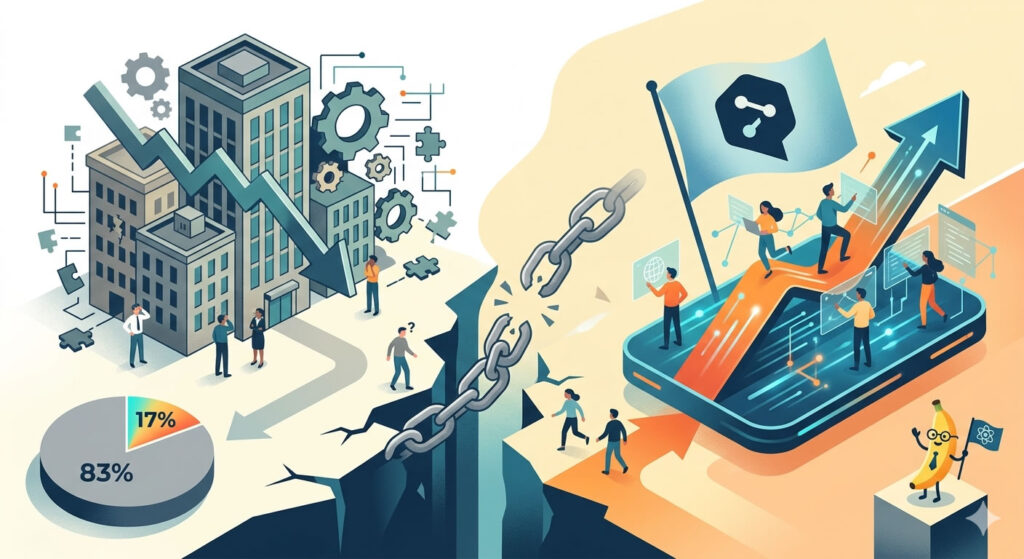
Despite widespread AI investment, only 17% of organizations have implemented next-generation language AI tools — such as large language models or agentic AI systems — for their multilingual operations. The remaining 83% are still working with manual processes, traditional automation paired with human review, or legacy systems designed for a very different era of business.
The numbers break down as follows:
- 35% of international businesses still handle translation entirely through manual processes
- 33% rely on traditional automation combined with systematic human review
- 17% have deployed modern, AI-driven translation and language workflows
What makes this gap particularly significant is the scale of content these organizations are managing. According to the report, enterprise content volume has increased by 50% since 2023 — yet the majority of companies are still processing that content through workflows that haven’t meaningfully evolved.
AI Is Everywhere — Except Where Language Matters
The central paradox the report identifies is not that companies are avoiding AI. Most enterprises have deployed artificial intelligence in some form, whether in customer analytics, finance, supply chain, or internal productivity tools. The problem is that language workflows — the processes that underpin global sales, legal communications, customer support, and international expansion — have been left behind.
This is a significant oversight. The report identifies the business functions most directly affected by multilingual operations:
- Global expansion — the top driver of language AI investment, cited by 33% of respondents
- Sales and marketing — 26%
- Customer support — 23%
- Legal and finance — 22%
These are not peripheral functions. They sit at the core of revenue generation, regulatory compliance, and customer relationships. When language workflows fail to scale, the entire business feels the strain.
Jarek Kutylowski, CEO and founder of DeepL, summarized the situation directly: « AI is everywhere, but efficiency is not. » His point — that deploying AI in isolated pockets does not automatically produce productivity at scale — cuts to the root of why so many enterprises are underperforming despite significant technology investment.
What Is Language AI, and Why Does It Matter Now?
Language AI refers to artificial intelligence systems specifically designed to automate translation, multilingual communication, and language-based workflows at enterprise scale. This goes well beyond simple translation tools.
Modern language AI platforms are capable of handling real-time voice and text translation, automated content localization across multiple languages, AI-driven document processing for legal and compliance materials, and autonomous agents that can detect, route, translate, and publish content without human coordination.
The distinction between a basic translation tool and a language AI system matters enormously in practice. A basic tool translates text. A language AI system integrates into existing business infrastructure — connecting with CRM platforms, marketing systems, customer support tools, and document management workflows — so that multilingual communication happens automatically as part of normal business operations rather than as a separate, manual task bolted on afterward.
For businesses operating across multiple markets, this difference is the gap between scaling globally and being held back by the operational cost of translation at volume.
The Reasons Behind the Gap
The report’s findings raise a natural question: why have language workflows been so consistently overlooked when enterprises have been willing to invest heavily in other areas of AI?
Several structural factors contribute to the lag.
Fragmented Legacy Processes
Translation and multilingual workflows in most organizations are deeply embedded across departments — handled through email requests, outsourced vendor relationships, spreadsheet-based localization tracking, and siloed document management systems. These processes evolved organically over years and do not lend themselves to easy replacement. They work well enough at low volume but fail visibly as content demands grow.
Weak Integration with Core Business Tools
Traditional translation workflows typically operate separately from the platforms businesses rely on most — their CRM, their marketing automation, their customer support software. This disconnection creates bottlenecks and inconsistencies that worsen as global operations expand.
Security and Compliance Concerns
For organizations in regulated sectors — financial services, healthcare, legal, and government — the hesitation to send sensitive documents through external AI systems is entirely understandable. Data privacy requirements, regulatory obligations, and the handling of confidential materials create genuine barriers to adoption that general-purpose AI tools do not always address adequately.
The Sovereignty Question: Why Compliance Is Becoming a Differentiator
One of the more nuanced aspects of the report is how it frames data sovereignty as an increasingly important factor in enterprise AI platform selection. As regulated industries accelerate their AI adoption, the ability to control exactly where data goes — and to revoke that access instantly — is becoming a primary evaluation criterion rather than a secondary consideration.
DeepL’s own positioning reflects this shift. The company holds ISO 27001, SOC 2 Type 2, and GDPR certifications and offers Bring Your Own Key encryption for enterprise customers. This architecture gives organizations the ability to withdraw data access at will, placing their content effectively beyond reach of any party, including the platform provider itself.
For enterprises that cannot route sensitive documents through public cloud endpoints belonging to large technology providers, this level of control represents a meaningful functional difference rather than a marketing distinction.
Sebastian Enderlein, CTO at DeepL, described 2026 as a year when the focus shifts decisively from experimentation to execution: businesses that spent 2024 and 2025 running pilots are now ready to deploy at scale, and the platforms they choose will need to meet enterprise security standards from the ground up.
DeepL Agent and the Move Toward Autonomous Language Operations
The broader product shift underway at DeepL reflects a wider trend in enterprise AI: the move from single-function tools that perform a specific task on demand toward autonomous agents that manage entire workflows end-to-end without requiring human coordination at each step.
DeepL Agent, which reached general availability in November 2025, is designed to operate across business systems — navigating CRM platforms, email, calendars, and project management tools — to handle multilingual tasks autonomously. The agent identifies content that requires translation, routes it through appropriate workflows, applies quality controls, and delivers localized outputs, all without requiring complex custom integrations or manual oversight for routine tasks.
The practical implications for businesses are substantial. A marketing team launching a campaign across fifteen countries no longer needs to manage a sequential handoff between content creation, translation request, vendor coordination, review, and publication. An agentic language system handles the pipeline automatically, with human review reserved for the decisions that genuinely require judgment rather than applied to every step as a default.
According to DeepL, the company currently serves more than 200,000 business customers across 228 markets, with approximately 2,000 of those customers actively deploying AI agents for tasks including report analysis, sales targeting, and legal document review.
The Real-Time Voice Translation Shift
Separate research from DeepL, conducted in December 2025 across five thousand senior business leaders in the same markets covered by the Borderless Business report, surfaces another data point worth noting. Today, 32% of executives report actively using real-time voice translation in their business operations. By the end of 2026, 54% believe it will be essential to how they work.
The pace of that shift varies significantly by geography. The United Kingdom and France are leading early adoption at 48% and 33% respectively, while Japan sits at 11%. This variance points to meaningful differences in enterprise readiness across global markets — differences that will likely influence both the pace of competition and the timing of investment in different regions.
The Business Case: What Modernization Delivers
Beyond the operational arguments, the financial case for language AI adoption is becoming difficult to ignore. According to DeepL’s reporting, a commissioned study found that organizations deploying language AI achieved a 345% return on investment through a combination of efficiency gains and cost reductions.
The drivers of that return are well-documented at a practical level:
- Reduced dependence on external translation vendors and the overhead that comes with managing them
- Faster time-to-market for international product launches and marketing campaigns
- More consistent quality across multilingual customer communications
- Lower operational cost for customer support in multiple languages
- Improved accuracy and turnaround time for legal and compliance document translation
The Borderless Business report finds that 71% of business leaders say transforming workflows with AI is a stated priority for 2026. The gap between that intention and the 17% who have actually modernized their language operations is the central challenge the report describes — and the market opportunity DeepL is directly addressing.
What This Means for Enterprises in 2026
The picture the Borderless Business report draws is one of a specific, addressable gap that is growing more consequential as content volumes rise and global market expansion accelerates. Enterprises that have made the transition to modern language AI are operating with a meaningful structural advantage: they can scale communication faster, reach new markets with less friction, and manage compliance-sensitive multilingual content with greater control and lower risk.
Those still dependent on manual or legacy translation processes face compounding challenges. As content volume continues to grow — up 50% since 2023 and unlikely to slow — the operational cost of doing translation the old way increases proportionally. The workflows that functioned adequately at previous scale become progressively less sustainable.
DeepL’s chief scientist, Stefan Miedzianowski, framed the current moment as a decisive point on the technology adoption curve: 2025 was when public awareness caught up with what AI agents can do, and 2026 is when enterprise adoption at scale actually happens — a transition from innovators and early adopters to the early majority.
For business leaders still evaluating whether language AI belongs on their technology roadmap, the data in this report makes a straightforward argument: the question is no longer whether to modernize multilingual operations, but how quickly the cost of not doing so becomes larger than the cost of change.
Sources: DeepL Borderless Business Report (March 2026)


